
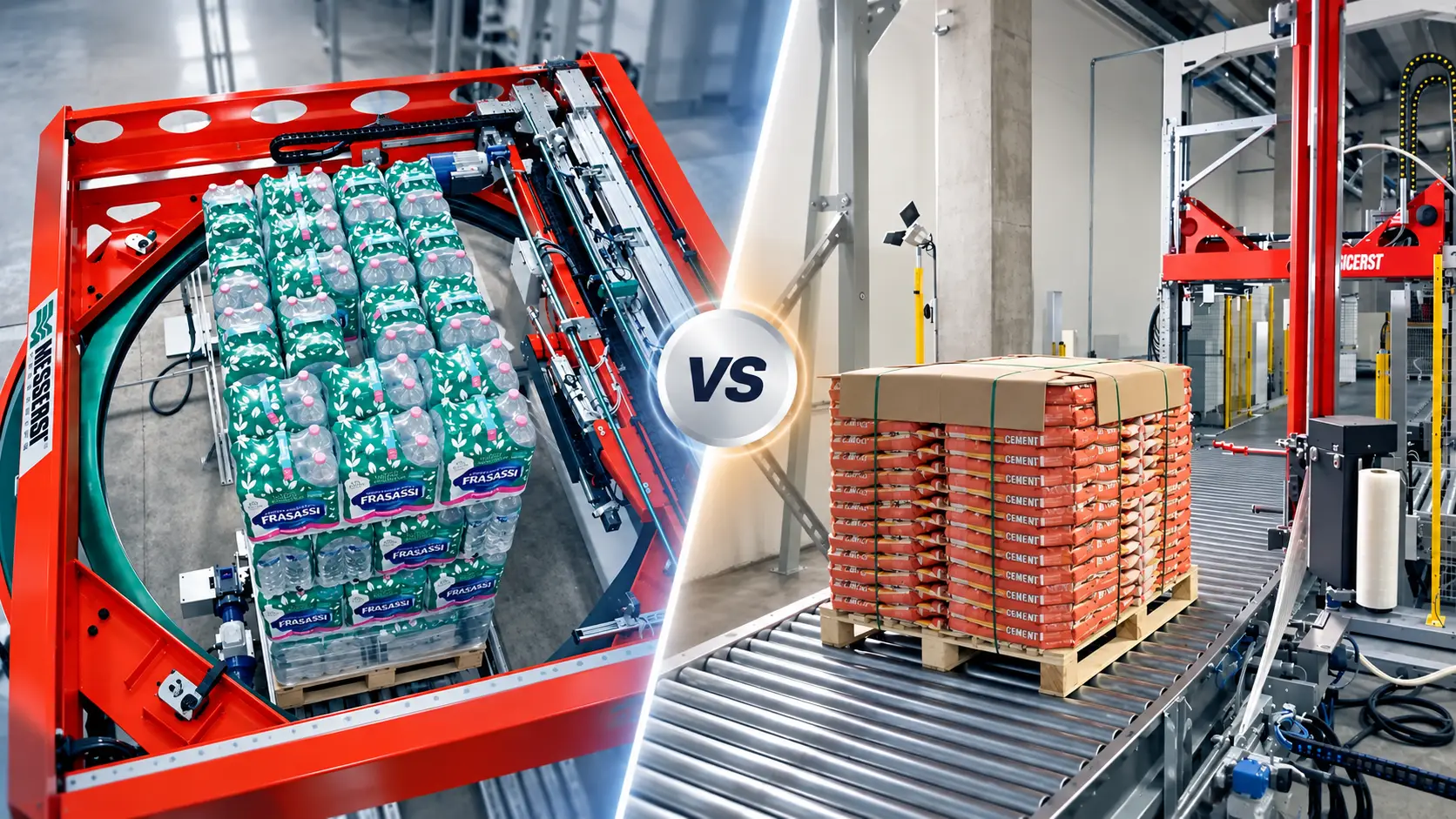
When a load must not rotate during wrapping, two automatic solutions should be compared: the rotary arm stretch wrapper and the rotary ring stretch wrapper. In both systems, the pallet remains stationary while the film application unit travels around the product.
The main difference is therefore not load movement. It lies in the machine architecture, required output, operating intensity and the efficiency expected from the end-of-line system.
Two ways to wrap a pallet without rotating it
In an automatic rotary arm stretch wrapper, a motorised arm rotates around the load while the film carriage applies the programmed height and overlap.
In an automatic rotary ring stretch wrapper, the ring carrying the film application system rotates around the pallet and moves to complete the wrapping pattern.
Both technologies avoid exposing the load to the acceleration of a turntable. They can therefore be considered for tall, heavy, deformable pallets or loads with low cohesion between layers.
Rotary ring vs rotary arm: key differences
| Criterion | Rotary arm | Rotary ring |
|---|---|---|
| Load movement | The pallet remains stationary | The pallet remains stationary |
| Rotating element | Arm with the film carriage | Ring with the film application system |
| Output of the Robotec configuration | Up to 80 pallets/hour | Up to 100 pallets/hour |
| Operating profile | Flexible automation and demanding production | Continuous production and high output |
| Project priority | Adaptation to the load and process | Performance, continuity and availability |
| Available pre-stretch | Up to 300% | Up to 300% |
| Integration | Conveyors and automatic end-of-line systems | Conveyors and high-performance automatic lines |
These capacities refer to Robotec Packing’s current configurations. Effective output also depends on pallet height, the number of film revolutions, programmed reinforcements, pallet infeed and outfeed, and the equipment before and after the wrapper.
When to choose a rotary arm stretch wrapper
A rotary arm is suitable when the load must remain stationary and the required output does not justify moving directly to a ring solution. It is not restricted to low throughput: Robotec’s configuration can reach up to 80 pallets per hour and is built for intensive industrial use.
It should be considered particularly when:
- Pallets are heavy, tall, irregular or have limited stability.
- Rotating the load could displace products or deform the unit.
- Wrapping must be automated with adjustable programs, clamping, cutting and sealing.
- Rotary arm capacity covers the required output with sufficient margin.
When to choose a rotary ring stretch wrapper
A rotary ring is aimed at lines where wrapping must keep pace with continuous production and where a small difference in cycle time can constrain the entire end-of-line system. Robotec’s configuration reaches up to 100 pallets per hour.
This system is particularly relevant when:
- The line operates at high output for extended periods.
- The wrapper could become the system bottleneck.
- Fast cycles coordinated with automatic conveying are a priority.
- Machine availability has a direct impact on production.
If robustness is understood as the ability to accumulate cycles with stability and continuity, the ring architecture is particularly well suited to intensive production. Its balanced rotating assembly and simplified design aim to reduce wear and maintenance. This does not make the rotary arm a fragile solution: it also has an industrial construction, but occupies a different output range within the product family.
Efficiency means more than speed
Both solutions can work with film pre-stretch of up to 300%. Actual consumption depends on load geometry, the number of revolutions and reinforcements, containment force and film properties. It would therefore be inaccurate to claim that one technology always consumes less film than the other.
On a high-output line, the ring can improve overall efficiency through greater throughput and continuity. In another application, the arm can deliver the required performance with a more closely matched solution. Efficiency should be assessed across the complete process, not only in pallets per hour or grams of film.
The information engineering needs to decide
Before selecting a technology, gather:
- Minimum and maximum load dimensions, weight, height and stability.
- Current output, target output and expected growth.
- Operating hours and production shifts.
- Wrapping pattern, required protection and film specification.
- Connected equipment, available space and maintenance areas.
This information makes it possible to calculate the real cycle, check the available capacity margin and define the machine integration within the end-of-line system.
Frequently asked questions
Does a rotary ring wrapper rotate the pallet?
No. The pallet remains stationary while the ring and film application system move around the load.
Which system is better for an unstable load?
Both avoid rotating the load. The decision depends mainly on output, wrapping pattern, operating intensity and integration with the rest of the line.
At what output should a rotary ring be considered?
There is no universal threshold. The real cycle time should be calculated with sufficient margin over target output. In Robotec's range, the rotary arm reaches up to 80 pallets per hour and the rotary ring up to 100.
Which stretch wrapper uses less film?
It depends on the load, pattern and film control. Both configurations allow up to 300% pre-stretch, so consumption must be compared using the actual wrapping program.
A decision based on the load and production requirements
Rotary arm and rotary ring systems meet the same basic requirement: wrapping a pallet without rotating it. The arm provides a flexible solution for demanding automation; the ring adds capacity, continuity and availability when production output is higher.
Robotec Packing designs and integrates both technologies within automatic pallet wrapping lines. Send us your formats, weights, required output, film pattern and operating hours so that our team can compare the alternatives and define the right solution. Contact our engineering team.